
Institutional Links
- Instituto Superior Técnico - IST
- University of Lisbon
- Department of Chemical Engineering
- Centro de Recursos Naturais e Ambiente - CERENA
- Fundação para a Ciência e a Tecnologia
Funding
 |
 |
 |
 |
Research page

Climate transition is imposed to all sectors of the EU economy, including CCI, especially through more efficient use of resources.
Amongst CCIs, Galleries, Libraries, Archives and Museums (GLAMs) require large quantities of energy for controlling Volatile Organic Compounds (VOCs), Nitrogen Oxides (NOx), Hydrogen Sulfide (H2S) and humidity for cultural heritage (CH) artifacts conservation due to the absence of smart and efficient Indoor Air Quality (IAQ) control technologies.
SIMIACCI improves traditional IAQ solutions, such as CH storage/showcases conditioning, heating ventilation, and air conditioning (HVAC), by developing a portfolio of innovative solutions reducing related energy demand by 30-50%) and extent CH conservation time.
Funding:
European Union’s Horizon Europe research and innovation program under grant agreement N° 101178095. More information on the project can be found at www.simiacci.eu.

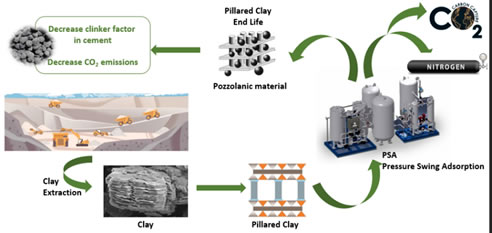
Our project proposal is focusing on an adsorbent material – pillared clays (PILCs) – that is very interesting for carbon capture using PSA in the cement industry because:
The side figure summarizes the concept of our project to exploit the existing natural clays to produce adsorbents (PILCs) that are used to capture CO2 and later can be reused by the cement industry in cement production.
Funding:
Innovani of the Global Cement and Concrete Association under Core project B2. More information on the project can be found at gccassociation.org/innovandi/gccrn/.

Acute respiratory distress syndrome (ARDS) is seen in huge numbers of patients worldwide. Respiratory diseases are the third largest cause of death in the EU. Currently available therapy options for respiratory failure are associated with high morbidity and mortality. In BioMembrOS, we follow a groundbreaking new biomimetic approach, and replicate main characteristics of the most effective respiration found in vertebrates, mainly birds and fish, in order to develop membrane structures that will serve as key elements for a novel generation of artificial respiration devices.
To reach this goal, we will
Funding:
European Union's Horizon Europe research and innovation program under grant agreement N° 101130006. More information on the project can be found at https://biomembros.eu/.
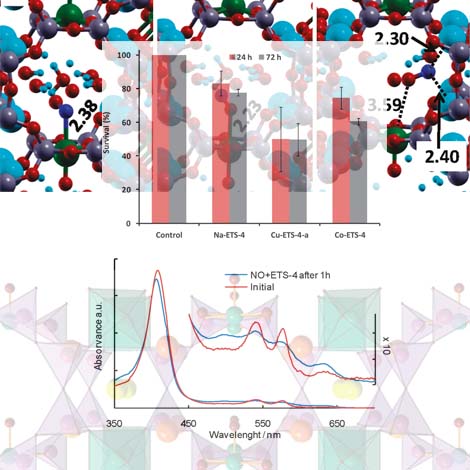
The delivery of gasotransmitters, namely nitric oxide and hydrogen sulphide, to target sites in the human body canlead to new therapies of several important diseases. These molecules act as signalling transmitters in the regulationof several vital systems. Current homogenous donors, based on organic molecules, do not allow an efficient targetdelivery of gasotransmitters at specific sites of the human body, because they become distributed throughout tissuesand fluids causing unwanted side effects and deregulating the normal functioning of tissues and systems. Moreover,most homogenous donors form very toxic molecules that stay in the body after the release of the gasotransmitters.This is a significant drawback on the development of efficient therapeutic applications with these molecules.Nanoporous materials can store gases and will be used to develop delivery vehicles of gasotransmitters, to deploythem at target sites in the human body for therapeutic action, solving the problems associated with homogenousdonors. By engineering the pore system, the chemical nature and the external surface, the new vehicles will achievecombined unprecedented properties: (i) high storage capacity of stable gasotransmitters, (ii) tuneable slow releasein physiological media during several hours, (iii) excellent biocompatibility. To reach these goals, a rational design ofthe materials will be achieved by understanding the interactions of the gases with the binding sites, at the molecularlevel. The application of biocompatible polymer layers at the surface of the nanoporous materials will be used for thefirst time to simultaneously improve the biocompatibility and produce a slow release profile of the stored gases.The final challenge will be to demonstrate the control of biological processes, using the new materials that releasethe gasotransmitters slowly during several hours. Preliminary assessment of therapeutic application to wound healingwill be done, demonstrating the feasibility of the storage/release with the new delivery vehicles. These results will bea first validation for topical applications. The methodology for preparing the vehicles can be generalized to severaltypes of nanoporous materials and will open a pathway for future research on new therapeutic applications with localgasotransmitters delivery. Today, a method to release slowly small molecules from porous materials is lacking and theresults of this project will open a path for research on other molecules/applications.
This project (PTDC/MED-QUI/28721/2017) is funded in part by FCT - Fundação para a Ciência e a Tecnologia.
Funding:
Although nitric oxide (NO) is very toxic in low concentrations it plays a key role in the regulation of several biological systems of the human body. Solid carriers have potential biomedical interest in the delivery of exogenous NO for anti-bacterial, anti-thrombic and wound healing applications. In this research line, we prepare and modify nanoporous materials with the main goal of studying its potential in the field of storage and release of nitric oxide for therapeutic applications. This project (IF/00993/2012/CP0172/CT0013) is funded in part by FCT - Fundação para a Ciência e a Tecnologia.
The objectives of the project are:
Funding:
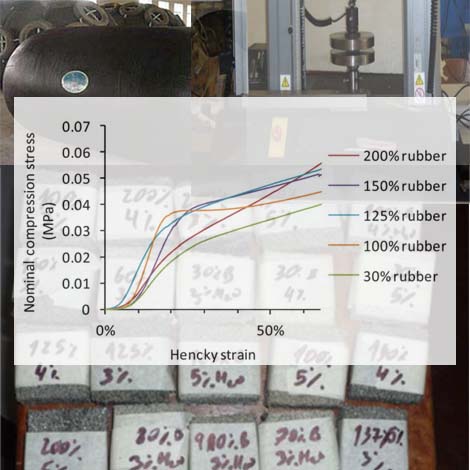
Rubber from end-of-life tires is being used to develop composite foams with interesting properties for some applications. After grinding, the rubber obtained from the tires can be incorporated in the polyurethane foams. This project is funded by Valorpneu.
The objectives of the project are:
Funding:

This project aims at developing high-resolution in-situ solid-state nuclear magnetic resonance (ssNMR) methods, adapted to variable pressure measurements, to gain an atomic-level understanding of the surface interactions between nanoporous inorganic-organic hybrid sorbent materials and gas mixtures mimicking industrial flue gas streams relevant in low- and high-pressure (postand pre-combustion) CO2 capture. We focus on the elucidation of CO2 adducts formed at CO2 partial pressures in post- (<0.5 bar) and pre-combustion (~10-50 bar) processes using isotopically-labelled 13CO2. The study of surface species derived from flue gas contaminants is also envisaged.
This project (PTDC/QEQ-QAN/6373/2014) is funded in part by FCT - Fundação para a Ciência e a Tecnologia.
Funding:


A huge percentage of the recent European cultural heritage (CH) can be found in movies, photographies, posters and slides produced between 1895 and 1970 were made using cellulose derivates. More than 75 years of visual and audio memories are in serious danger to be lost due to the natural instability cellulose acetate (CA).
NEMOSINE improves the traditional storage solutions, such as freeze storage (below 5ºC), by developing an innovative package with the main goal of energy saving and extent conservation time.
This project has received funding from the European Union's Horizon 2020 research and innovation programme under grant agreement Nº 760801
Funding:

|
|
|
|
 Research Gate
 Linkedin
 Twitter