
Week 1 (4th Period)
- António Morais
- Tiago Teixeira
- 4th Period - Weekly Progress
- April 21, 2024
2D Path Planning/Guidance
During Week 7 (3rd Period), the first of two main tasks for 2D Path Planning/Guidance was completed. This involved modifying an existing node to dynamically adjust to changes in the robot’s height when converting the 3D point cloud acquired by the OS1 sensor into obstacles on a 2D map.
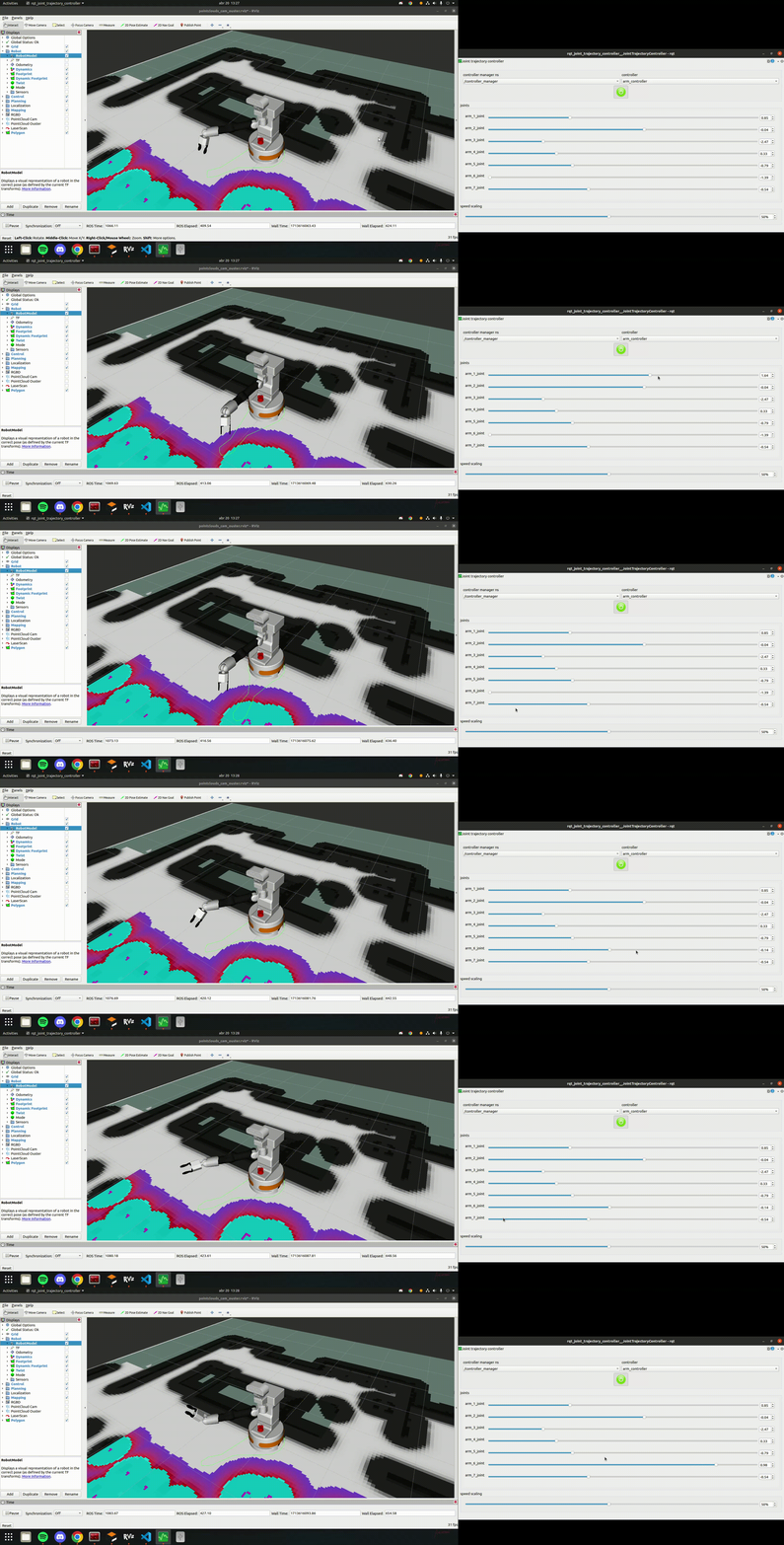
Moving forward into the current week, the focus shifted to the next task: calculating an accurate footprint for the robot that updates in real time in response to changes in the robot’s arm position. Previously, the robot’s footprint was a simple circle, which was adequate when the arm was retracted but became inaccurate as its position changed.
To address this, a new ROS package containing a single Python node was developed, responsible for calculating and updating the footprint on both the global and local costmaps at a specified frequency. The following steps outline the implementation process:
-
Adding virtual point coordinates forming a circle to a set of points.
-
Calculating the projection on the xz plane of the transform of all robot frames to the base frame and adding these coordinates to the previous set of points.
-
Adding four virtual points around each point from the robot’s arm to simulate thickness.
-
Utilizing the alphashape module to calculate the coordinates for the polygon formed around this set of points.
-
Updating the footprint parameters in the global and local costmaps using the calculated polygon.
In Figure 1, the robot’s footprint (green line on the ground) can be seen updating in real time as the robot’s arm is moved.
3D Mapping
→ LIO-SAM
Following the updates in Week 7 (3rd Period), the team proceeded to find some intrinsic parameters of the Inertial Measurement Unit (IMU) that are required as inputs in the LIO-SAM/config/params.yaml file of the algorithm.
# IMU Settings - the following numbers are examples
imuAccNoise: 3.9939570888238808e-03
imuGyrNoise: 1.5636343949698187e-03
imuAccBiasN: 6.4356659353532566e-05
imuGyrBiasN: 3.5640318696367613e-05
To identify these parameters, the team delved into researching various resources, including the documentation of the IMU. However, despite their efforts, they didn’t uncover the specific parameters needed. Fortunately, it was found that others had encountered the same issue and suggested utilizing a package designed for this purpose. This led the team to explore the imu_utils
package, a tool recommended by fellow users. While diving into this solution, some challenges were encountered. The code itself was error-free, but difficulties arose with one of its dependencies, namely the code_utils
package from the same author.
The initial error arose when attempting to build the package itself, specifically the code_utils
package, due to an include problem. This issue has also been documented in detail in issue #12
on the GitHub repository of imu_utils
.
// File path: code_utils/src/sumpixel_test.cpp
include "backward.hpp"  // wrong - insert '#' at the beginning
include "code_utils/backward.hpp"  // corrected - insert '#' at the beginning
The subsequent errors are outlined in issue #32
on the GitHub repository of imu_utils
. Essentially, there are several macros that need to be modified within the files code_utils/src/mat_io_test.cpp and code_utils/src/sumpixel_test.cpp.
// Change the ones on the left to the ones on the right
CV_LOAD_IMAGE_GRAYSCALE -> IMREAD_GRAYSCALE
CV_MINMAX -> CV::NORM_MINMAX
CV_LOAD_IMAGE_UNCHANGED -> IMREAD_UNCHANGED
And finally an error on the code_utils/CMakeList.txt file:
set(CMAKE_CXX_FLAGS "-std=c++11")  # wrong
set(CMAKE_CXX_STANDARD14)  # corrected
With all of these errors taken care of, it became possible to run the package. However, to do so, a dataset was required. This dataset needed to consist of at least two hours of IMU data, which was exactly what was obtained.
Afterward, a .launch file was created for the IMU being used. In this file, the topic of the IMU data, the name of the IMU, and the minimum duration of data collection (in minutes) were modified.
<launch>
    <node pkg="imu_utils" type="imu_an" name="imu_an" output="screen">
        <param name="imu_topic" type="string" value= "/imu/data_raw"/>  <!-- Changed IMU topic name -->
        <param name="imu_name" type="string" value= "px4"/>  <!-- Changed IMU name -->
        <param name="data_save_path" type="string" value= "$(find imu_utils)/data/"/>
        <param name="max_time_min" type="int" value= "105"/>  <!-- Changed minimum time (in minutes) for collection of data -->
        <param name="max_cluster" type="int" value= "100"/>
    </node>
</launch>
Once these adjustments were made, the package could be executed with the constructed dataset. Following this, the team obtained the necessary parameters:
#  File path: imu_utils/data/px4_imu_param.yaml
%YAML:1.0
---
type: IMU
name: px4
Gyr:
   unit: " rad/s"
   avg-axis:
      gyr_n: 1.8191460790771266e-03  # imuGyrNoise
      gyr_w: 4.5119119003007975e-05  # imuGyrBiasN
   x-axis:
      gyr_n: 1.9496415895800541e-03
      gyr_w: 4.1344704259625771e-05
   y-axis:
      gyr_n: 1.6858078760147014e-03
      gyr_w: 6.7641044580978528e-05
   z-axis:
      gyr_n: 1.8219887716366247e-03
      gyr_w: 2.6371608168419629e-05
Acc:
   unit: " m/s^2"
   avg-axis:
      acc_n: 2.5432491530286979e-02  # imuAccNoise
      acc_w: 7.9166594255487604e-04  # imuAccBiasN
   x-axis:
      acc_n: 3.4098258318774562e-02
      acc_w: 9.3291404872930051e-04
   y-axis:
      acc_n: 2.2888249908200251e-02
      acc_w: 7.7128773939743591e-04
   z-axis:
      acc_n: 1.9310966363886121e-02
      acc_w: 6.7079603953789149e-04
Next week, the team’s efforts will be focused on finding other parameters required for the algorithm under discussion, which will be described in next week’s post.


