Status of Solution Development
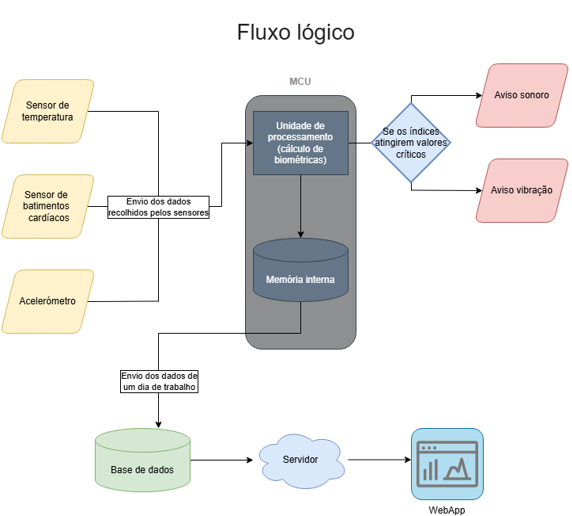
Our technical solution has evolved significantly. We have transitioned to the XIAO ESP32-C6 microcontroller for its superior power management and compact size. The system now features an expanded sensor array (Skin Temp, Heart Rate, Accelerometer, Ambient Temp/Humidity) and a robust data persistence strategy using RTC memory to minimize Flash wear.
Achieved Results
- Standardized USB-C Data Flow: Seamless transfer during charging via a dedicated hub, reducing complexity for the end user.
- Advanced Power Strategy: Consumption under 0.05 mW in deep sleep and under 65 mW during activity; 8-10h operational autonomy.
- Biometric Fusion: Real-time integration of HR and Skin Temp using a Kalman Filter (Welch & Bishop, 2006) for core temperature estimation.
- Safety Alert Logic: Full implementation of HSI (Heat Stress Index) and PSI (Physiological Strain Index) based triggers.
- Sensor Array Finalization: Addition of humidity and ambient temperature sensors to calculate Heat Index accurately.
- Partnership Growth: Established strong ties with SMAS, FMH, Mota-Engil, and Civil Protection for prototype testing and validation.
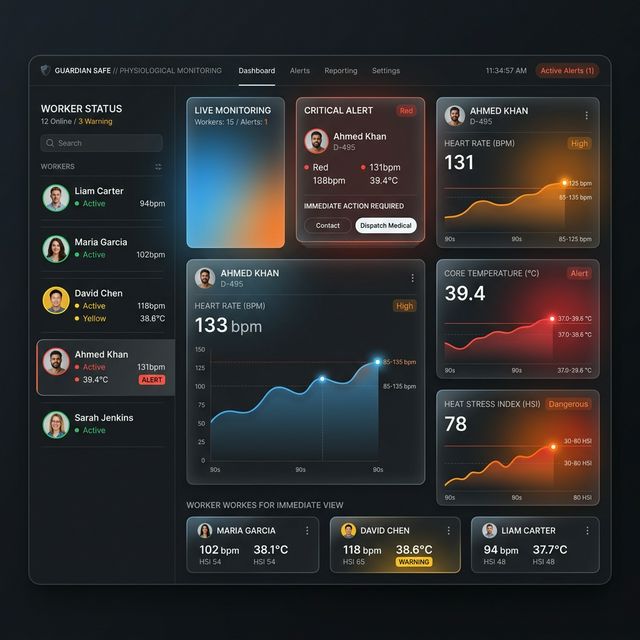
- Ecosystem Development: Supabase (PostgreSQL) and Vercel-hosted monitoring dashboard established for remote analysis.
- Website & Communication: Continuous updates to our blog and site to share progress and research findings.
Challenges & Deviations
- Partner Engagement: Initial delays in scheduling validation meetings (now resolved).
- Sensor Selection: Complexity in selecting clinical-grade sensors for ±0.1°C accuracy.
- Schedule Shift: Extended the stakeholder meeting phase until late March to ensure professional feedback.
- Prototyping Acceleration: Hardware development was brought forward to mitigate technical risks.
Team Contributions
- Martim Neves: Project management; Web development; Selected low-power MCU and clinical-grade sensors; Redesigned site interface; Researching data export and visualization strategies; Validated prototype requirements with IP.
- André Branco: Project management; Research on design development and participation in partner meetings; Meeting scheduling (FMH, Mota-Engil, Proteção Civil, IP); Solution requirement list; Meeting with Mota-Engil and FMH.
- Artur Moreira: Eletrocap project proposal; Website development and updating; Interviews report on the blog; Solution requirement list.
- Vicente Rosa: Hardware Component Research; Research on communication protocols and optimal sensors (precision-focused); Research on minimum battery capacity requirements; Meeting with Proteção Civil and FMH.
- Manuel Costa: Partnership Development; Eletrocap project proposal; Partner communication and meeting scheduling (SMAS, EDA, IP); Armband placement validation; Research on testing and validation methodologies.
- André Alves: Physiological Monitoring Research; Research on biometrics in strenuous conditions (PSI/HI); Comparative Analysis and Core Body Temperature Estimation Algorithms; Solution requirement list; Meeting with Mota-Engil and FMH.
Schedule of Activities
- April: Prototype assembly and initial bench testing.
- May: Field tests with partners (Mota-Engil / Proteção Civil).
- June: Data validation, algorithm refinement, and final results presentation.