Project Description
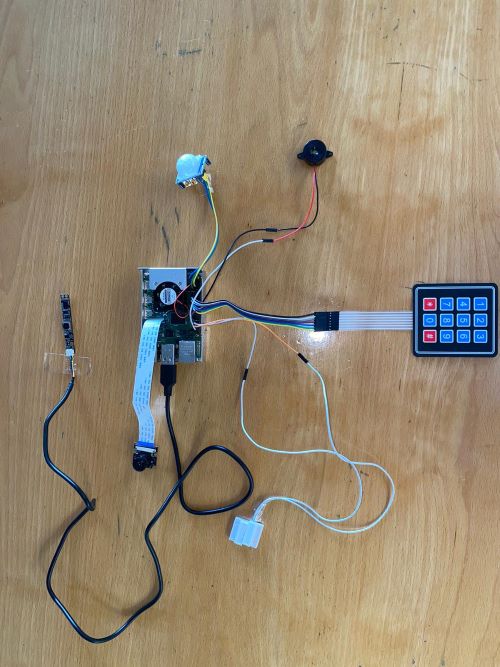
Home security is essential for safeguarding individuals, their families, and their belongings. In today’s fast-paced world, where technological advancements continue to redefine our daily lives, the need for innovative solutions to protect our homes has never been greater. Our project aims to create an alarm system with a high level of automation to ensure house security monitoring. This system revolves around a central computation unit (Raspberry Pi Model 4B) capable of integrating various sensory inputs from a diverse array of sensor types, including motion sensors and cameras, with its primary objective being the integration of an access control mechanism using facial recognition technology. It is engineered to be flexible, able to effortlessly adjust to different sensor setups and to operate reliably under various lighting conditions and camera angles. This means that whether there are more or fewer sensors installed, the system can adjust appropriately. The flexibility extends to the types of sensors utilized in each setup, allowing for customization based on specific needs. In addition to its hardware components, the system incorporates a user-friendly mobile application. This app serves as a centralized platform for users to interact with their security system. Through the app, users receive real-time alerts about any detected suspicious activities, particularly focusing on entries verified by the facial recognition cameras. Users have full control over the system’s functions, including the ability to disable the alarm once they are informed of potential threats. Overall, the combination of hardware and software elements forms a comprehensive solution aimed at enhancing both security and the user experience.
Our project aims to develop an access controller, where all the computations are done via a microcomputer, in our case, a Raspberry Pi Model 4B, which runs an algorithm that performs both a facial recognition algorithm (based on the Open Computer Vision’s Deepface model), as well as an algorithm that uses a overhead chamera which can detect the movement of people entering or exiting a specific room.
In order to enable the user to have feedback from the system , our team is developing an Android App that can reliabily receive information from the system, with image recordings in the event of an intrusion. A detailed schematic of the systems’s operability can be seen here : Access Controller Schematic
By joining both the access controller system , centered around a computational unit (Raspberry pi Model 4B), and the mobile application , our team aims at developing a successfull access controller for residential units like apartments, which remotely provides notifications to the user depending on an unauthorized entrance in a room/apartment where the system is installed. Given the system’s simplicity , it is expected to be easily used by every user.