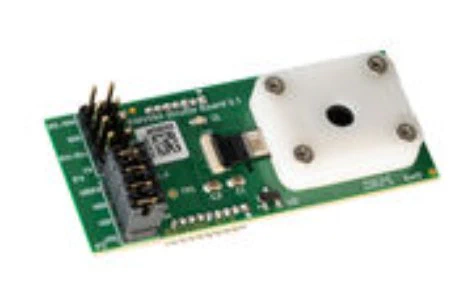
For monitoring fine particulate matter, we selected the Bosch BMV080 solid-state sensor mounted on the Shuttle Board 3.1. This device uses a high-precision laser to measure PM2.5 concentrations—microscopic particles that the World Health Organization identifies as critical for cardiovascular and respiratory health.
The main technological advantage of this module is its fanless operation, which enables near-instant measurements while consuming around 80% less energy than conventional sensors. By communicating via the I2C bus with the ESP32-S2, the BMV080 ensures seamless integration and low overall power consumption, while maintaining a silent and efficient operation suitable for a wide range of environments.
Comparative Analysis and Rejection of Our Initial Option (HM3301):
During the planning phase, we conducted a detailed analysis of the use of the HM3301 sensor from Joy-IT. However, we ultimately decided not to adopt this solution due to its mechanical and energy-related limitations.
The use of an internal fan in the HM3301 would not only triple the device’s battery consumption, but also generate residual heat and vibrations inside the prototype enclosure. This internal heating would create an artificial microclimate, directly compromising the reliability of the CO₂ sensor (SCD41), gas/VOC sensor (BME690), as well as temperature and humidity measurements.
To ensure data integrity and maximize device autonomy, Bosch’s solid-state technology proved to be the only viable option for this sensor ecosystem. Additionally, this approach avoids the need for extra materials to isolate sensors or the development of a highly specialized enclosure to mitigate these issues.