Seventh Week - A Turning Point




Table of Contents
Introduction
As we crossed the halfway point of the program, this week marked a natural moment for reflection.
Our team shifted gears from development and exploration to sharing our journey — both the progress made and the lessons learned along the way. The Mid-Program Presentation was our main milestone, allowing us to consolidate the project’s evolution and articulate the reasons behind the choices we’ve made so far.
Alongside that, we also had a meaningful technical meeting with the firefighters, deepening our understanding of what a truly effective fall detection solution needs.
Our Mid-Program Presentation

Reaching the midpoint of our project gave us the chance to pause, reflect and take stock of how far we’ve come — and how much our project has evolved. What began as a broader concept around outdoor monitoring and chatbot assistance has since been reshaped into a more grounded, actionable solution focused on in-home safety and caregiver peace of mind.
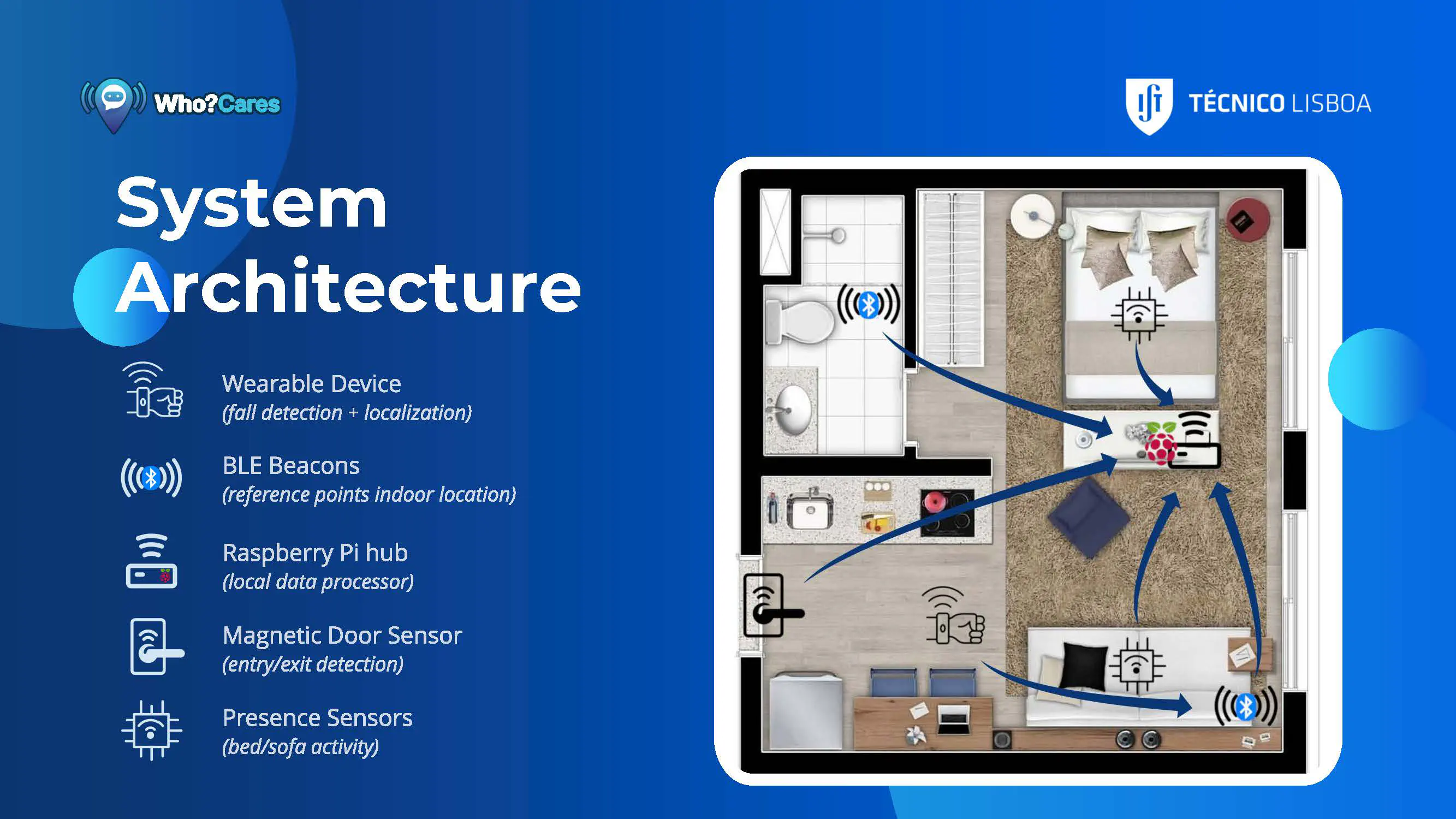
In our Mid-Program Presentation that we’ve prepared, we share this new direction, highlighting the pivot in our technical scope. Instead of GPS-based tracking and AI chatbot interactions, we are now developing a localized sensor-based system that combines a wearable device, Bluetooth beacons and edge processing to monitor safety at home in a more context-aware, privacy-conscious way.
This shift wasn’t accidental. It came after over 10 interviews with caregivers and healthcare professionals, where we uncovered recurring pain points that existing products still leave unaddressed — especially the need for discreet, reliable in-home monitoring without relying on internet connectivity or complex apps. You can read more about those insights in our Week 4 blog post.
During the presentation preparation, we designed the updated system architecture: a lightweight wearable for fall detection and localization, strategically placed sensors (like magnetic door sensors and presence pads on beds/sofas) and a Raspberry Pi hub processing data locally to generate meaningful alerts:
We also reflected on different parts of our project — from hardware development, user testing strategies, how we distributed responsibilities to stay aligned as a team and the deviations from our original plan. Our initial project timeline had to be revised to account for the new technologies we’re exploring and the removal of chatbot/GPS-related tasks. Rather than being setbacks, these changes brought clarity and better alignment with the real-world needs we’re aiming to meet.
Overall, stating our progress was not only an opportunity to think about what we’ve built so far — it was a valuable checkpoint to confirm that we’re on the right path. The feedback we’ve been getting on the past few weeks helped us strengthen our testing plans and continue prioritizing solutions that are both implementable and meaningful to the people we’re designing for.
We’re now entering the second half of the journey — with a clearer vision, a prototype about to be starting its development and a renewed sense of motivation to bring Who?Cares to life.
People and Associations We Spoke With
While our presentation preparation was the main event, we also had an impactful follow-up meeting with the Sapadores Firefighters, joined by two members of the center of social intervention and citizen support (RSLB-NISAC).
Interview with a team from the Firefighters Social Intervention
The focus this time was clear: how can we ensure our system truly responds to the realities of emergency responders and the people they assist? These were some of the key takeaways from this meeting:
- Accuracy Above All: Fall Detection Must Be Reliable
A major takeaway was the critical importance of precise fall detection. False alarms can quickly erode trust in a system, while missed events can have dire consequences. Ensuring high reliability in detecting real falls — and filtering out false positives — is now one of our top engineering priorities.
- Sensor Strategy: Acelerometer + Altimeter Combo
The team suggested exploring a hybrid approach using accelerometers (to detect sudden movement) and altimeters (to measure elevation changes). This could improve the accuracy of detection, but we still need to research the right balance between precision, cost and energy efficiency.
- Form Factor Matters: Bracelets over Smartwatches
We also discussed user comfort. Instead of a smartwatch-style device, which can be bulky or unfamiliar to older users, we’re now leaning toward a bracelet-style wearable. More adaptable and comfortable, this format could encourage more consistent use — and better outcomes.
- Fast & Dependable Alerts
Every second counts in an emergency. The firefighters emphasized the need for rapid, dependable alerts — without delay or unnecessary noise. This means designing for low-latency communication and edge-processing where possible.
- Location? Only Where It Works
We revisited geolocation and reached a clear consensus: it’s not reliable enough outdoors and indoor GPS is essentially useless. Legal constraints around precise tracking further complicate its use. So our solution will focus entirely on indoor environments, where we can deliver more control, clarity and results.
- Exit Detection as a Standout Feature
Our idea to detect when someone leaves the house was highlighted as highly. The firefighters pointed out that very few (if any) current solutions offer this kind of feature, reinforcing its value and potential impact.
- Battery Use: Insights and Limitations
The firefighters shared that many of their own wearable tools operate on low-power watch-style batteries, which offer long-lasting autonomy. While we appreciated the insight, our current solution has more demanding power requirements, making that specific option less viable for us at the moment. Still, energy efficiency remains a key priority in our design.
(The full document of their takeaways and advice in PDF)
Week Recap
Week 7 gave us exactly what we needed: a moment to step back and see the bigger picture, backed by thoughtful feedback and frontline insights. From a deep project reflection to a reality-grounded meeting with emergency professionals, we left the week with sharper direction and stronger conviction.
As we enter the next phase, our focus sharpens on turning design into reality. The road ahead is hands-on — and exciting.
-
Prototyping with selected components
-
Testing assumptions with partners and users
-
Continuously refining system logic and usability
There’s a renewed energy in the team — not just from what we’ve already built, but from what’s still possible.